How the work actually unfolds.
The whole shape, before you pay for any of it.
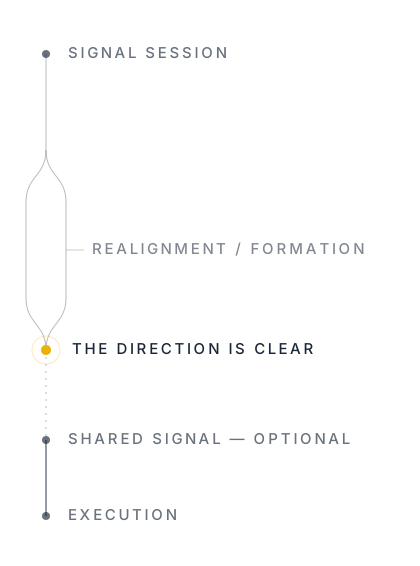
60 minutes, $200. The single entry point. One insight, and an honest recommendation: proceed, wait, or work with someone else.
The ongoing work, in one of two shapes. Realignment recovers a direction that exists. Formation finds one that has never been named.
Optional, and only after the individual work holds. The direction moves into the team.
Building it – with the people who were in the room when the direction was found.
The gold node marks the point where the direction becomes clear. Nothing gets built before it.
Mirror → Depth → Challenge → Dream → Build
Movements, not steps. They overlap, they recur, and the engagement is paced by you. However, the order matters, and skipping one is why other attempts stalled.
Mirror
We start by contrasting the business you actually operate with the one you meant to build. Putting both on the table exposes the gap between them, often surfacing hidden avoidances like unmade decisions or neglected work rather than purely strategic problems. This honest, sometimes exposing process produces the accurate description required for any real progress. Every subsequent step relies on this baseline, because building on a flattering but false picture renders everything that follows useless.
Depth
We push past the surface problem you arrived with to find the unspoken issue underneath, recognizing that a strategic dilemma often masks a deeper personal or operational conflict. This slow and occasionally frustrating phase requires patience as obvious answers are set aside until the true question surfaces. Producing this actual, underlying question is vital before applying any pressure. Rigorously testing the wrong question is the most expensive mistake you can make.
Challenge
The emerging direction undergoes rigorous load testing to see if it survives sacrifice, loss of revenue, or disappointment. This intentionally adversarial phase breaks apart borrowed ambitions inherited from others or past versions of yourself. Testing the direction in this way produces either a path you can confidently defend when inconvenient, or the valuable realization that you cannot. Discovering a direction is not truly yours is much cheaper now than realizing it years later.
Dream
Once your true direction is confirmed, we widen the frame to explore its full, unconstrained scale. This is not a motivational exercise but a specific correction for the tendency to build something safe and overly small following past disappointments. While it can feel uncomfortable to state your ultimate ambition out loud, this phase establishes the true size of your vision so it can be built toward at a sane pace. Applying ambition to a borrowed direction only amplifies a mistake, making this step strictly sequential.
Build
Finally, the signal translates into structure by capturing your direction in a usable format that dictates what you will pursue and what you must rule out. This stage feels both relieving and immediately demanding, as sudden clarity forces real consequences and settles postponed choices. It produces the Vision Blueprint and a definitive decision set to guide future actions. This must always happen last, because imposing structure before a direction is proven real results in nothing more than a well-organized guess.

Same five movements. Different centre of gravity.
Realignment spends much longer in Mirror and Depth. There is a built history (years of decisions, a team, a client base) and most of the work is excavating what actually happened and why, before anything can be redirected.
Formation spends much longer in Challenge and Dream. There is no structure to reason from, so the risk is not distortion but borrowing: building something that sounded right when someone else described it. The direction has to be tested for ownership early, and the frame has to be widened on purpose.
- Honesty, including about the parts that are unflattering. The work runs on your account of things, so an edited one produces an edited direction.
- Willingness to be challenged without treating it as an attack.
- Willingness to sit with a question for a week without resolving it. Premature answers are the main way this work fails.
- The discipline to do the work between sessions. Most of the movement happens there.
- Hand you a direction. If it arrives from outside, you will drop it the first time it costs something.
- Apply a blueprint from another business. Yours is not a variant of theirs.
- Reassure you before there is anything to be certain about.
- Give you tactics while the direction is still open. That is the sequence this practice exists to change.
There is no ceremony, and it is not a subjective feeling. Four things happen, usually within a fortnight of each other:
- You articulate the direction unprompted, in your own words, and it comes out the same way twice.
- Decisions that had been stuck start resolving on their own, because there is now something to run them through.
- You arrive at sessions with concrete next steps instead of searching for shape.
- The reason holds when it is challenged, including by people who liked the previous version.
If execution follows, nothing has to be re-explained. The Vision Blueprint becomes the brief, so the people building are working from the reasoning rather than a summary of it. And they were in the room when the reasoning happened. The usual translation loss between the founder’s intent and the delivered work simply doesn’t occur, because there is no translation.
One real question per movement. Published, because nothing else shows the substance faster.
“Why did you even start back then?” and if you haven’t started yet: “What do you keep coming back to?”
“If the problem you came in with were solved tomorrow, what would still be true?”
“If no one you respect ever found out you had built it, would you still want to?”
“What is the version of this you have not allowed yourself to say out loud?”
“Which decision have you been postponing that this direction now answers?”